You Got An MRI Of Your Shoulder And There Is A Labrum Tear. What Does That Even Mean?
Since joining the military, it seems every other one of my patients has a labrum tear. Grapplers and special operators, especially. So let's break down what the labrum actually is.
First, What’s the Labrum?
Your shoulder is a ball and socket joint. I usually tell my patients it's like a golf ball on a tee.. The socket is super shallow, more like a golf ball sitting on a tee than a ball in a deep cup. That design gives your shoulder an incredible range of motion, which is great for grappling, climbing, and any other crazy shit combat athletes do. The tradeoff is that it is far less stable than a joint like your hip.
The labrum is a ring of cartilage that lines the rim of the shallow socket. It looks like a big washer or bumper surrounding the entire socket. It deepens the cup, adds stability, and acts as a suction cup and block to dislocating. When it tears, you lose some of that built-in stability.
There Are Three Main Types You'll Hear About:
SLAP Tear
Bankart (Anterior) Labrum Tear
Circumferential (Anterior and Posterior) Labrum Tear
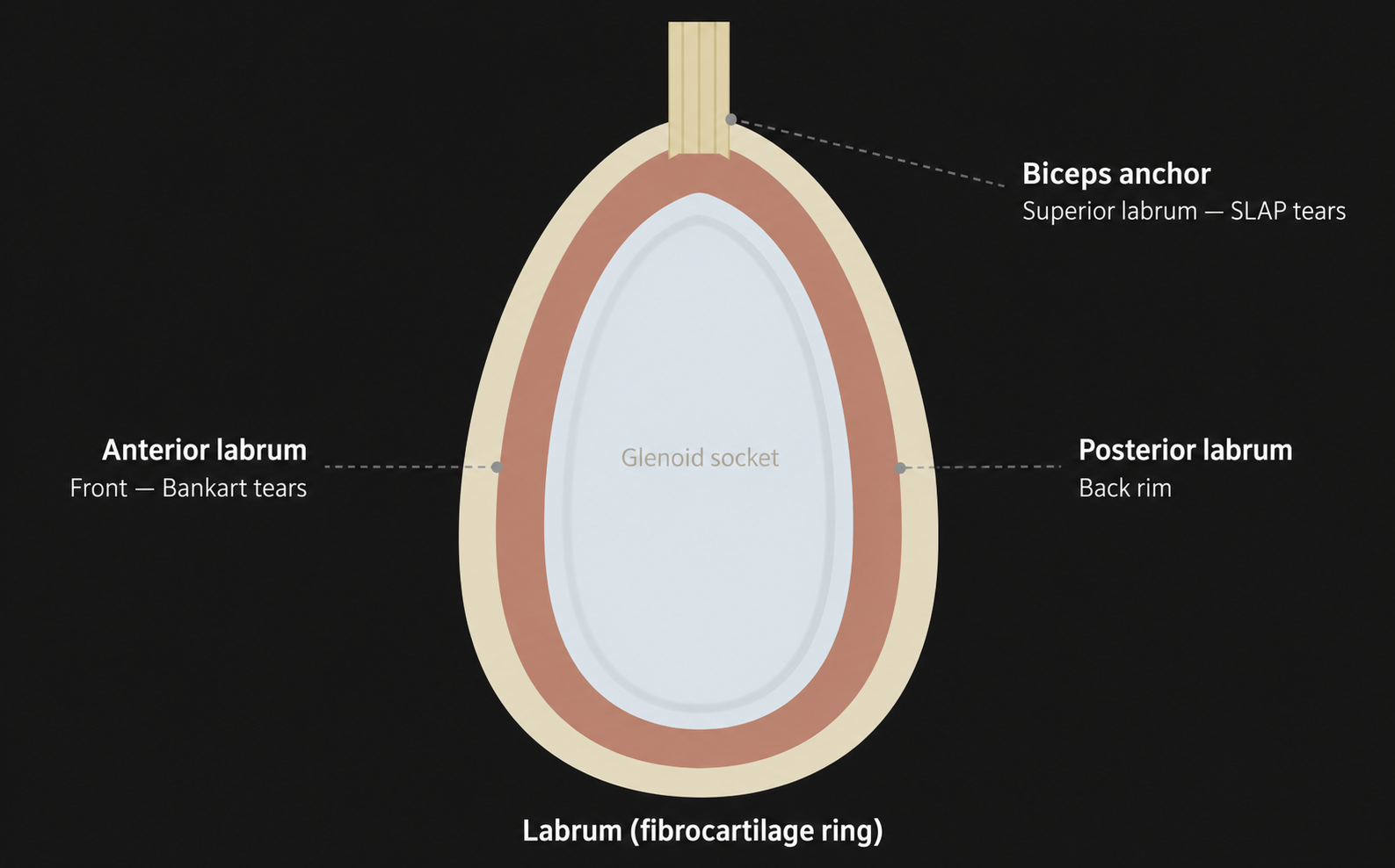
Created by Claude. Face on view of the glenoid, biceps, and labrum
A SLAP tear is at the top of the labrum where the biceps attaches and is the most common. These usually come from repetitive overhead stress or a fall on an outstretched arm. I usually tell my patients, “if you MRI everyone in my office, most people will have a SLAP tear.”
A Bankart tear is at the front-lower labrum and is often caused by an actual shoulder dislocation. At least that was the case when I was a civilian doctor.
But, now that I am a military surgeon, these guys tear the front and back of their labrum (circumferential labrum tear), often without a dislocation. It is wild!
Mechanism of injury and location of tear, as well as what the athlete wants to get back to, matter a lot when we talk about treatment.
Final Thoughts
The most important thing today is learning about what a labrum is and that it may be present on your MRI, but doesn’t always mean it’s the culprit of your pain.
That is why I never treat the MRI. I treat the athlete in front of me. How it happened, whether the shoulder is actually unstable, what the exam shows, and what you want to get back to matter far more than the words on a radiology report.
So before you spiral over that report, take a breath. Understanding what type of tear you have and how it happened is step one. What we actually do about it is where it gets interesting.
Next week I’ll break down the treatment side, both nonoperative and operative, and when each one makes sense. Because not every labrum tear needs a surgeon, and knowing the difference is everything.
____
Dr. Megan Lisset Jimenez
Connect with Me
Let’s keep the conversation going:
📱 Instagram: @dr.meganjimenez
📘 Facebook: Megan Jimenez, DO
💼 LinkedIn: Megan Jimenez, DO