One Of The Most Common Referrals To My Office: Labrum Tear On MRI
Last week we covered what the labrum is and the types of tears (SLAP, anterior, circumferential). This week: do you need surgery, or not? The honest answer as a surgeon and athlete is that it depends, and what it depends on is not what you might think.
Just Because Its On The MRI, Doesn’t Mean Surgery
A labral tear on an MRI does not automatically mean that tear is causing your pain. Imaging routinely finds tears in athletes with zero symptoms and in plenty of people over 40 with no previous shoulder injury. I often tell patients, “If you MRI everyone in this office, most will have a labrum tear.”
That is why I do not treat the MRI. I treat the athlete. How it happened, whether the shoulder is dislocating, and what you want to get back to matter far more than the MRI read.
Nonoperative: Where Most People Start
For most SLAP tears and labrum tears (without dislocation), we start with physical therapy (PT). A 2023 meta-analysis found physical therapy produced outcomes comparable to surgery with fewer complications.
If your shoulder is stable and the problem is pain, we start with rehab built around scapular stability, rotator cuff strength, and the demands of grappling. We can also consider anti-inflammatories and injections. Most people do well here.
Operative: When The Shoulder Is Unstable
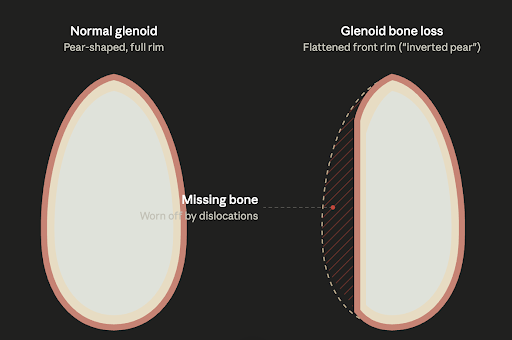
If your shoulder is dislocating, rehab alone often is not enough… especially for young athletes and those in contact sports, like jiu jitsu. The deciding factor between the two surgical options is usually glenoid bone loss, meaning how much bone has worn off the front of the socket from repeated dislocations.
Arthroscopic labral repair (Bankart repair) is a minimally invasive camera procedure. Tiny poke holes are made around the shoulder. The torn labrum is reattached to the rim with anchors. This is the workhorse when there is little to no bone loss.
Bony procedures (Latarjet or allograft). Once enough bone is gone, a soft tissue repair alone tends to fail. The old threshold was 20 percent bone loss, but the data has pushed it toward 13.5 percent, so we consider these earlier than we used to. The Latarjet moves a piece of bone with its tendon to the front of the socket to rebuild it. An allograft is where we take bone from a cadaver and create more bone in front of the patient’s shoulder. Bigger surgery, higher complication rate, but lower recurrence when there is bone loss.
Final Thoughts
Not every labral tear needs a surgeon. Most SLAP tears and labrum tears do well with rehab. Instability from dislocations often needs fixing, and how much bone you have lost determines whether that is a soft tissue camera procedure or a bigger bony rebuild.
Know which situation you are actually in. That comes from a good exam and an honest conversation, not a panic spiral over your MRI. Labrum surgery is so fascinating and every patient’s shoulder is different, which is what makes it so exciting for me.
____
Dr. Megan Lisset Jimenez
Connect with Me
Let’s keep the conversation going:
📱 Instagram: @dr.meganjimenez
📘 Facebook: Megan Jimenez, DO
💼 LinkedIn: Megan Jimenez, DO
References:
Hu B, et al. Arthroscopic Bankart Repair versus Conservative Treatment for First-Time Traumatic Anterior Shoulder Dislocation. Eur J Med Res. 2023.
MOON Shoulder Group 10-year follow-up, 2024; AAOS Shoulder Guidelines, 2025.
Shaha JS, Cook JB, Song DJ, et al. Redefining "Critical" Bone Loss in Shoulder Instability: Functional Outcomes Worsen With "Subcritical" Bone Loss. Am J Sports Med. 2015;43(7):1719-1725. PMID: 25883168