I had a string of patients with pectoralis major injuries this year. Ranging from acute to chronic to re-tears. It has been so common that my buddy and I decided to begin writing a research paper on pec tears from jiu-jitsu injuries. The couple I’ve seen this year have been as a result of jiu-jitsu, benching, and on guy who lifted a seizing teenager to get her to the ER (don’t ask).
Anatomy
There are 2 “heads” of the pec muscle. These are the sternal and clavicular heads, named because they originate on the sternum and clavicle (ie: collar bone). These 2 muscle bellies fuse to form 1 tendon which rotates and attaches to the humerus just lateral to the biceps tendon.
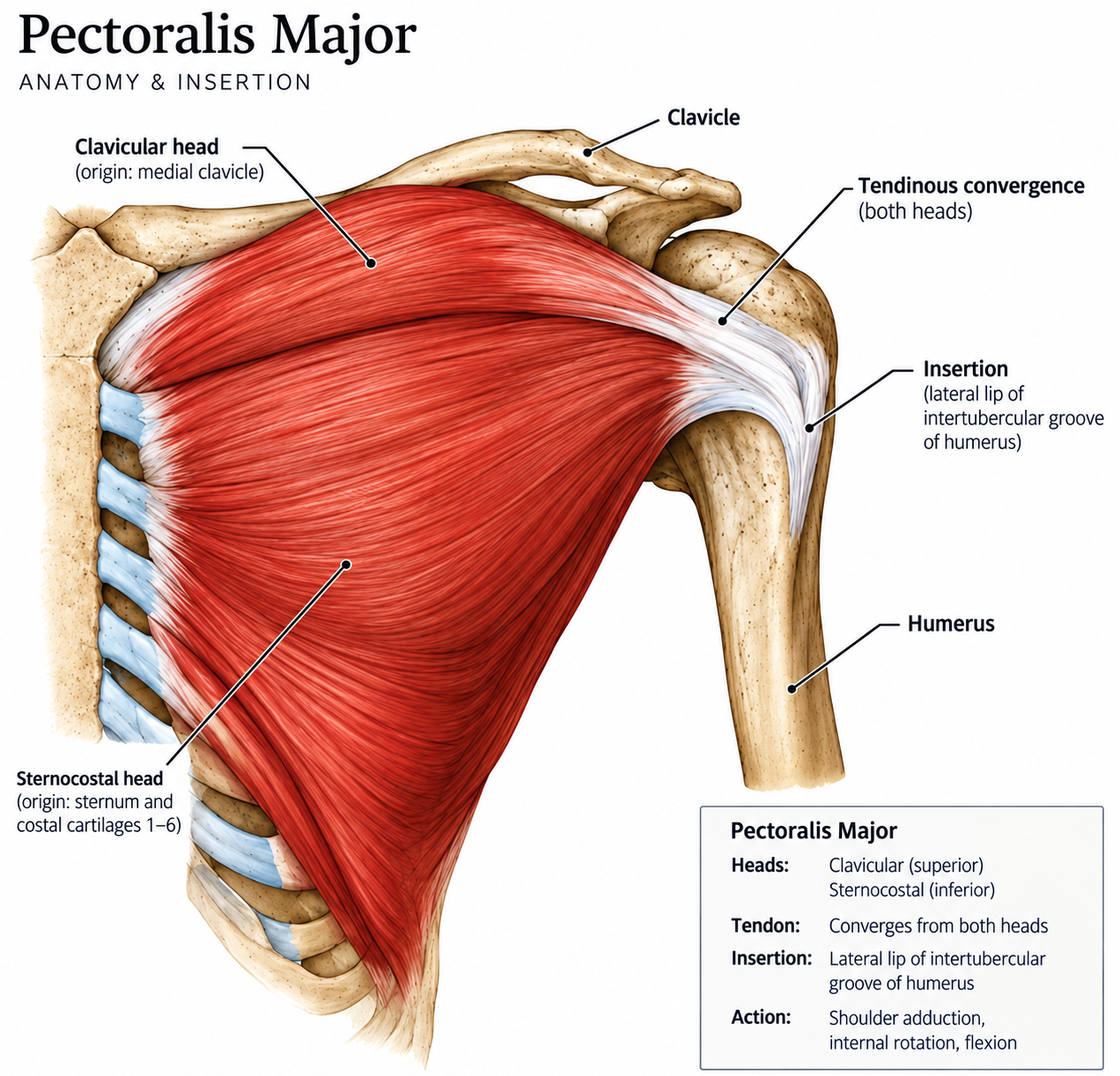
Generated by ChatGPT
Common Injury Patterns
The pec, like most tendons, tear due to eccentric loading. Essentially, the tendon and muscle are on full stretch, then the athlete contracts the muscle and the tendon rips off the bone. The most common injuries occur from bench pressing and sports.
Partial Vs. Complete Tears
As an ortho surgeon, I often see pec tears late because they are commonly read as “partial tears”. Many people assume these don’t require surgery. While they don’t require it, many patients are not satisfied being treated nonoperatively, especially when there is a deformity, pain, and weakness.
Partial tears consist of a wide scope of injuries. They can be complete sternocostal tears (just 1 head) or smaller muscular injury. The sternocostal tears are often missed and treated conservatively, but when there is a chest deformity and weakness, consider seeing a surgeon even if the MRI is read as “partial”.
Treatment Options
This depends vastly on the location of the injury, partial vs. complete, and chronicity. With a complete tear of the tendon, we attach the tendon back down to bone typically utilizing small buttons or anchors. When the tear occurs closer to the muscle-tendon junction there isn’t a lot of tissue to grab with suture. I think of muscle more like hamburger meat. Imagine trying to sew that! So we often add a graft which is made of human skin to strengthen the repair (ie: dermal allograft).
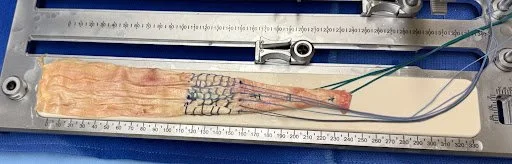
When people present months to years after injury or after a failed previous surgery, we often have to add a graft. My graft of choice is an achilles graft from a donor (ie: allograft). Below is a picture of a recent allograft I used for a revision pec tear.
Final Thoughts
The big takeaway: do not let the words “partial tear” on an MRI make the decision for you. Plenty of these are missed or undertreated, and if you have a chest deformity, weakness, or ongoing pain, it is worth seeing a surgeon who treats these injuries.
Pec tears are rare, but I see them more frequently in my population of soldiers and combat athletes, which is exactly why my buddy and I are digging into the research. The earlier we catch them, the easier the treatment. If something in your chest went pop under load and now looks or feels off, do not sit on it. Get it looked at.
____
Dr. Megan Lisset Jimenez
Connect with Me
Let’s keep the conversation going:
📱 Instagram: @dr.meganjimenez
📘 Facebook: Megan Jimenez, DO
💼 LinkedIn: Megan Jimenez, DO
References
Magone K, Ben-Ari E, Gyftopoulos S, Virk M. Pectoralis Major Tendon Tear: A Critical Analysis Review. JBJS Rev. 2021 Aug 20;9(8). doi: 10.2106/JBJS.RVW.20.00224. PMID: 34415856.
Marsh NA, Calcei JG, Antosh IJ, Cordasco FA. Isolated tears of the sternocostal head of the pectoralis major muscle: surgical technique, clinical outcomes, and a modification of the Tietjen and Bak classification. J Shoulder Elbow Surg. 2020 Jul;29(7):1359-1367. doi: 10.1016/j.jse.2019.11.024. Epub 2020 Feb 20. PMID: 32089403.